Molecular Plant Breeding2016, Vol.7, No.18, 1
-
8
4
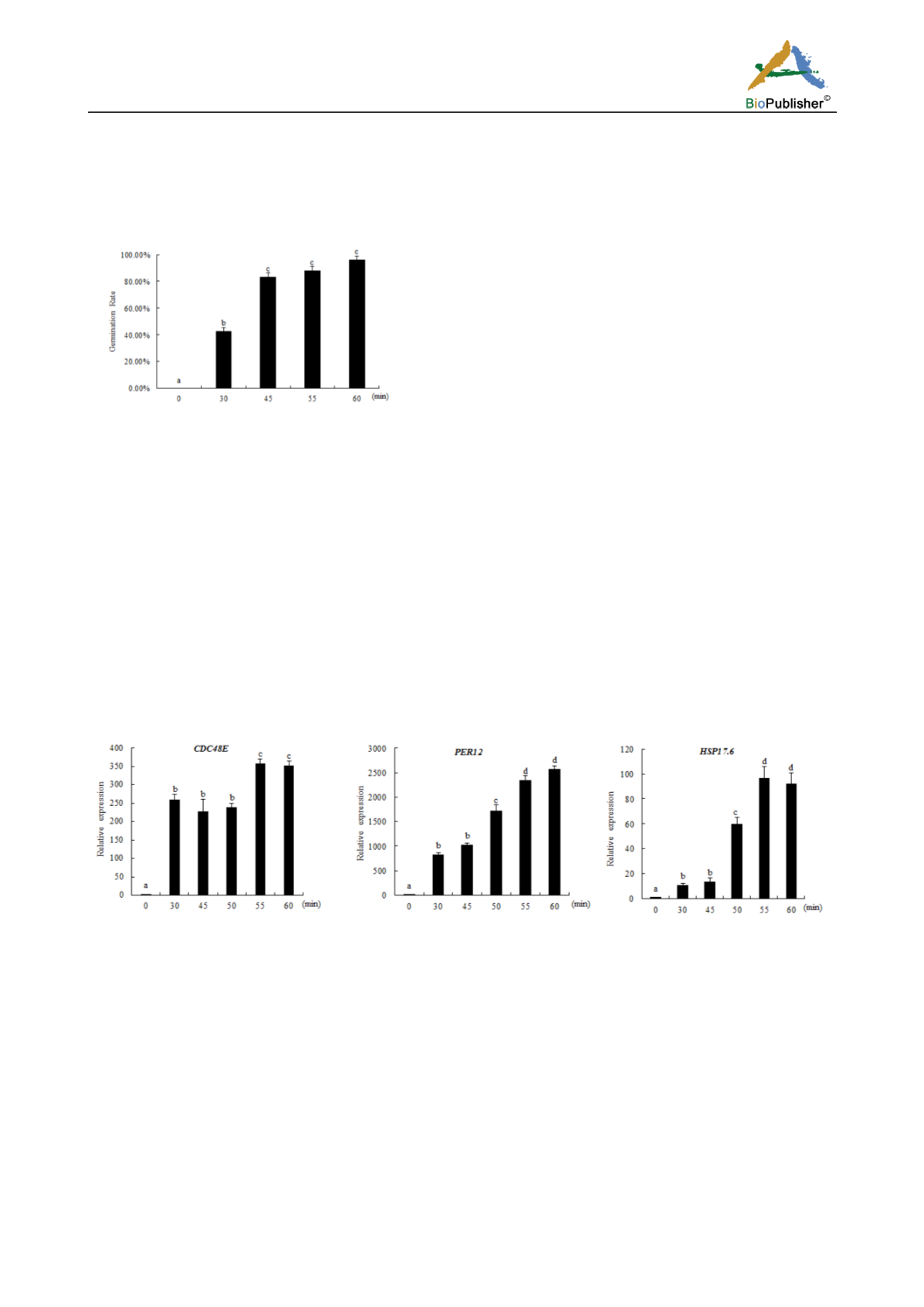
88.33%, and 96.11% respectively in 4°C conditions. That is to say, 40% of seeds can remove the germination
stagnancy and germinate at low temperature after treated for 30 minutes at 25°C; after treated for 45 minutes at
25°C, 83.33% of the seeds remove the germination stagnancy; and after treated for 60 minutes at 25°C, the
germination rate of seeds tolerance to low temperature reached germination rate at normal temperature, which is
almost all the seeds can remove the germination stagnancy.
Figure 3 Germination rates of the
Lepidium
seeds under low temperature after dealing with 25°C for different time
To further explore the relationship between the expression of screened-related protein in responds to low
temperature and germination of
L. apetalum
seeds, the expression of
CDC48E
,
PER12
and
HSP17.6
genes were
analyzed, after the seeds of low-temperature germination stagnancy were induced by different time of treatment at
25°C (Figure 4). Compared with the
L. apetalum
seeds of low temperature stagnancy, the expression of
CDC48E
,
PER12
and
HSP17.6
genes was extremely up-regulated (p<0.01) after treated for 30 min at 25°C, and the
expression showed a rising trend along with the increase of the treatment time within 60 min. Expression
characteristics of these three genes also have some differences.
PER12
,
CDC48E
gene were extremely
up-regulated for different time at 25°C, while the expression of
HSP17.6
gene was extremely up-regulated in the
treatment of 50-60 min at 25°C (p<0.01), and significantly up-regulated at 25°C, 45 min (p<0.05). The result is
consistent with the trend of that, more than 80% of the seeds can remove the germination stagnancy and germinate
at low temperature after treated for 45 min at 25°C. It also suggests that the proteins which expression was
up-regulation at 25°C closely related to remove the germination stagnancy of
L. apetalum
seeds at low
temperature.
Figure 4 The genes expression analysis at the different germination stage of
Lepidium apetalum
Willd
2 Discussion
Seed germination is a very complex process, which involves the regulation and expression of many proteins
associated with the growth and development. In this study, we choose
L. apetalum
seeds of the special ecotype
live in northern Xinjiang as research material. By comparing the different expression of protein before and after
removing the low-temperature germination stagnancy, the significantly up-regulated proteins of seeds, which
low-temperature germination stagnancy was removed, were screened and identified by mass analysis. Then, the
expression analysis of corresponding gene was performed for some of these proteins.
Heat shock protein is a kind of highly conservative molecule chaperones in the process of system development. It
can be divided into Hsp100s, Hsp90s, Hsp70s, Hsp60s and sHsps, according to molecular weight (KD). The first
four Hsp is considered HMW Hsps (high molecular weight Hsps), they are mainly involved in protein folding and
assembly. Hsp70B located in the cytoplasm membrane, chloroplast and cytoplasm, it participates in the


