Molecular Plant Breeding2016, Vol.7, No.18, 1
-
8
3
the process of development and germination, Hsp17.6I will express and localize in cytoplasm, it also plays the
role of molecular chaperone (Sun et al., 2001). After a brief heat shock to
L. apetalum
seeds, heat shock protein
will synthesized in response to environmental changes. Cell division control protein 48 homolog E is a member of
the cell division control protein family, it participates in the regulation of cell division, and may be involved in cell
division and proliferation during germination of seeds. Peroxidase (POD) has a relationship with respiration,
photosynthesis and auxin oxidatio, its physiological activity varied with the processes of plant growth and
development, and it may be involved in germination of
L. apetalum
seeds at low temperature. In subsequent
experiments, the expression of molecular chaperone Hsp17.6, peroxidase Per12 and cell division control protein
Cdc48E were further confirmed.
Figure 1 Comparison of 2-DE maps of total seed protein before and after germination stagnation under low temperature
Note: (a) unstratification seeds (b) seeds in germination stagnation (c) seeds lifted germination stagnation
1.3 Analysis of the relationship between the protein expression of
L. apetalum
seeds response to low
temperature and germination at low temperature
1.3.1 Analysis of the expression of
CDC48E
,
PER12
, and
HSP17.6
genes before and after removing germination
stagnancy of
L. apetalum
seeds
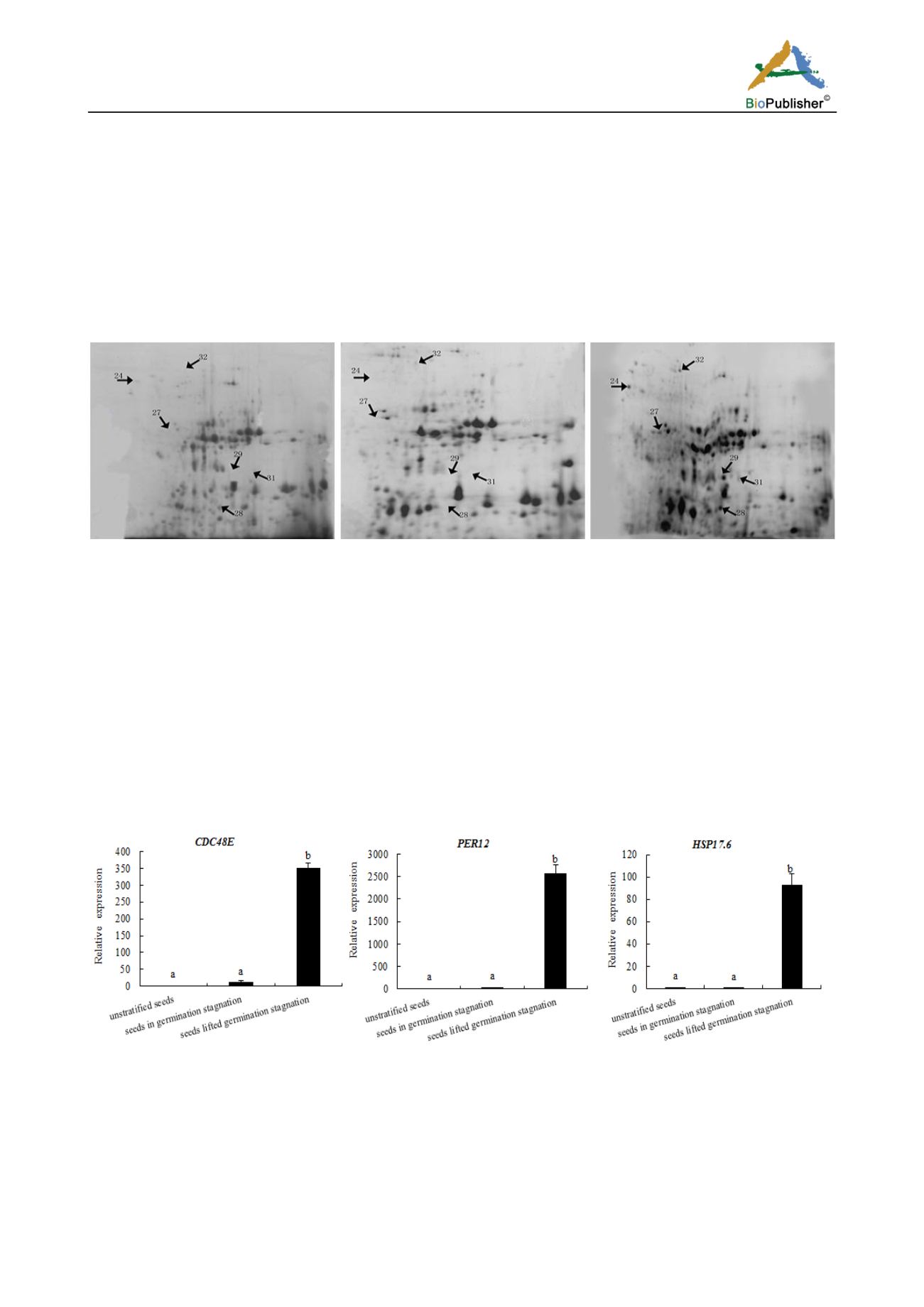
To further explore the effect of protein expression on the removing germination stagnant of
L. apetalum
seeds, we
compared the expression of
CDC48E
,
PER12
and
HSP17.6
genes of three groups of seeds in this study. The
results showed, these genes expressed very low in both the first group and the second group, but was significantly
up-regulated in the third group
.
It descript that, short thermal stimulation may promote the expression of
CDC48E
,
PER12
and
HSP17.6
genes, and the expression of these genes may closely associated with removing germination
stagnancy of
L. apetalum
seeds (Figure 2).
Figure 2 The genes expression analysis of
Lepidium apetalum
Willd before and after germination stagnation under low temperature
1.3.2 Analysis of the relationship between the protein expression of
CDC48E
,
PER12
and
HSP17.6
and low
temperature germination
L. apetalum
seeds, in the germination period of stagnancy after stratified for 10 d at 4°C, was treated for 0 min, 30
min, 45 min, 55 min and 60 min at 25°C, then the germination rate of it tolerate to low temperature was
counted(Figure 3). After induction treatment, the germination rate of
L. apetalum
seeds was 0%, 40%, 83.33%,
a b c


